


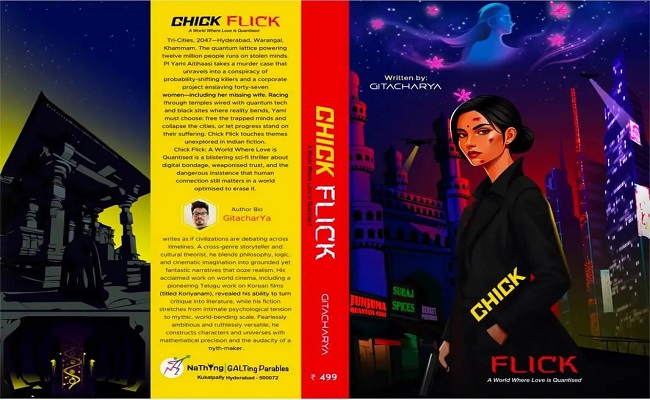
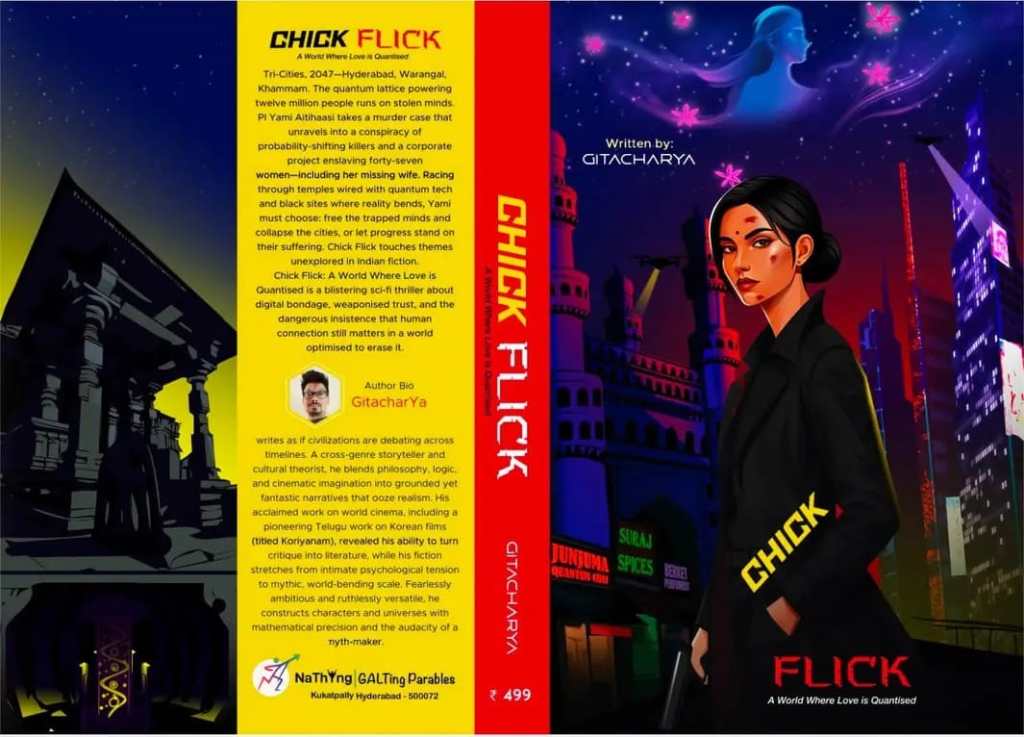
[A review of sci-fi novel ‘Chick Flick’ by Dr. Madhu Chittarvu.]

Introduction
Science fiction earns its keep by imagining what unbridled science and technology will do to society tomorrow, for good or ill. Of all the subjects available to a writer today, none offers more material than quantum technology: qubits that hold zero and one simultaneously, superposition, entanglement, wave-function collapse. These are no longer pure abstraction. Quantum computing is already a reality, even if full-scale deployment is still some years off. Science fiction got there first, of course: Schrödinger’s cat gave the world superposition and the observer effect decades before physicists caught up, and Everett’s many-worlds interpretation, in which every quantum decision spawns a new branching universe, has powered classics from Dark Matter to Frederik Pohl’s The Coming of the Quantum Cats.
It is in this tradition that Gitacharya sets Chick Flick, with Gen Beta protagonists and a quantum premise entirely his own. Gitacharya is a bilingual writer in Telugu and English, and among the very few voices bringing Telugu-rooted science fiction into English. The novel rewards a reader with at least a passing grip on quantum physics, and its racy, propulsive style will land squarely with a generation that is believing attachment is a burden, optimisation is a need, but entanglement is inescapable.
What is the novel about?
The story unfolds in 2047, across the tri-cities of Hyderabad, Warangal, and Khammam. Vishwatech, the corporation whose quantum lattice powers twelve million lives, is running that lattice on stolen minds. The project extracts the consciousness of XX-chromosome individuals, whose neurology processes the lattice’s demands more efficiently, and enslaves them to it. Our protagonist, Yami Aitihaasi, is a Gen Beta investigator: sharp, relentless, and in a chosen lesbian marriage with her soulmate, Saiee Krishnamurthy. Geethacharya renders their quantum entanglement, and the love within it, in his own inimitable register: erotic without ever tipping into the lewd. Saiee joins Vishwatech for a project and vanishes into the tri-city lattice; five years on, Yami still doesn’t know whether her wife is dead, alive, or trapped as a digitised consciousness.
When she’s working on a separate case, to investigate the murder of scientist Dr. Miriam Rao, Yami is approached by Vanessa Rathore, the formidably intelligent Vishwatech executive overseeing the extraction project, who is also coping with several deaths. Vanessa recruits Yami, dangling access to Vishwatech’s files and, with it, perhaps a route to Saiee, whose consciousness may be among the enslaved. Julian and Vir join Yami’s investigation, and what follows is a chase through the quantum lattice of the three cities: one corporate deception concealing another, and a truth that costs Yami and Vir dearly in blood and trust before it comes fully into view.
About the prose
Gitacharya has an uncanny gift for building a future quantum world inside the very real streets of the Telugu tri-cities (Telangana), and that is what gives this book its particular flavor within Indian science fiction. Except needing a bit of editing, his command over language usage is well known to his readers.
“When consciousness becomes infrastructure, deletion becomes policy.”
“When probability collapses you can’t unobserve. Choose carefully, Jaan – every observation changes everything.”
“Saiee knows her body like she knows quantum equations – intimately and completely. Her tongue finds a rhythm that builds pleasure in waves, each one cresting higher than the last.”
“If I get lost, if the quantum states scatter me across possibility space, promise me you will find me – even if it takes years, even if it seems impossible.”
“The Vishwatech compound squats in the industrial district like a digital fortress, its quantum-glass spires piercing the Hyderabad skyline and pulsing with data streams.”
Gitacharya writes with the confidence of someone who has done the physics homework and trusts his reader to keep up. A glossary of Gen Beta terms as an appendix, his own coinage “kawantam” for quantum (corruption of the words among the masses) among them, makes that easier.
Word play is Gitacharya’s forte and his previous work కొరియానం (Telugu) attests this. He breaks words apart and reassembles them for new meanings, and clubs together words from different languages to produce a single sharp phrase. One assessment of that early work said he uses words the way Bruce Lee used his limbs.
That instinct carried into కొరియానం: A Journey Thru Korean Cinema, his earlier Telugu-language study of Korean film, where he kept coining new words and pushing Telugu into forms it had not carried before. Chick Flick applies the same instinct to a new problem: instead of remaking Telugu, he extrapolates present-day Gen Z slang forward into the Gen Beta lexicon the novel needs, “kawantam” among the results. Many of the terms look plausible. The transition from Telugu కొరియానం to English Chick Flick, the commitment behind it is the same. He bends language to suit his narrative forms, without losing understandability.
To conclude
Chick Flick is advertised as a Neo Noir science fiction and a quantum thriller set in the real streets of Telangana tri-cities of near future, telling a story about what corporate ambition will exploit once consciousness itself becomes an asset. Commitment and empathy are what the book sets against that exploitation. It addresses themes Indian science fiction has barely touched, and it does so with a confidence that makes Gitacharya a genuinely original voice in the field. I expect readers will be following him well beyond this first book.
***
Written by: Gitacharya
Published by: Nathing’s GALTing Parables in collaboration with Telangana Publications
Pages: 242
Price: ₹ 250/-
For Copies:
Available in major book stores
Ph: 7075537176, 8008160011
~
Telangana Publications,
RTC Cross Roads
Hyderabad
Ph: 86399 72160


తెలుగులో సైన్స్ ఫిక్షన్ రచనలు ఒక ఉద్యమంలా చేస్తున్న రచయిత మధు చిత్తర్వు. వృత్తి రీత్యా డాక్టర్ అయిన వీరు మెడికల్ థ్రిల్లర్లు రాయడం స్వాభావికం. “ఐ.సి.సి.యూ”, “బై బై పోలోనియా”, “ది ఎపిడమిక్”, “కుజుడి కోసం”, “నీలీ – ఆకుపచ్చ” వంటి నవలలు రచించారు.