[The review of book ‘MrityomaaAmritangamayaa’ by Dr. Kallakuri Sailaja.]

A poem of remembrance, or an elegy, is a stream of compassion that wells up from the deepest grief of a poet’s heart. It is infact a wellspring that rises naturally from the raw wound of loss of someone dear. In any language, such expressions build a delicate bridge between the writer and the reader effortlessly.
After reading the elegies written long ago by the great People’s poet Kaloji on his wife Kantham’s demise and recently, the memorial poems written by Radheya in grief of losing his son, my mind remained clouded with sorrow for many days, travelling into a sphere wrought in melancholy. But ‘Mrityormaa Amritamgamaya’, written by Makineedi Surya Bhaskar, made me forget my surroundings and even the passage of time, carrying me into a realm of ethereal philosophical embrace.
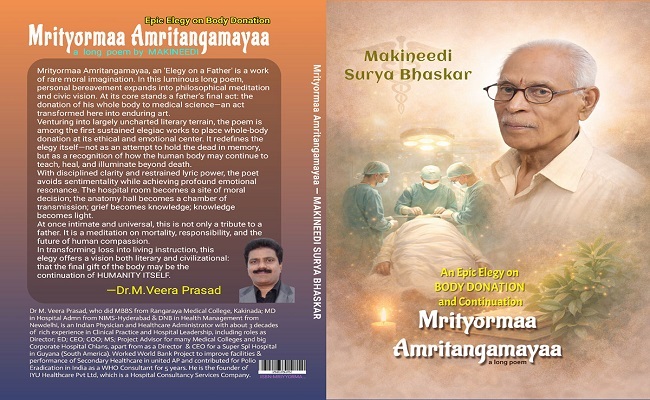
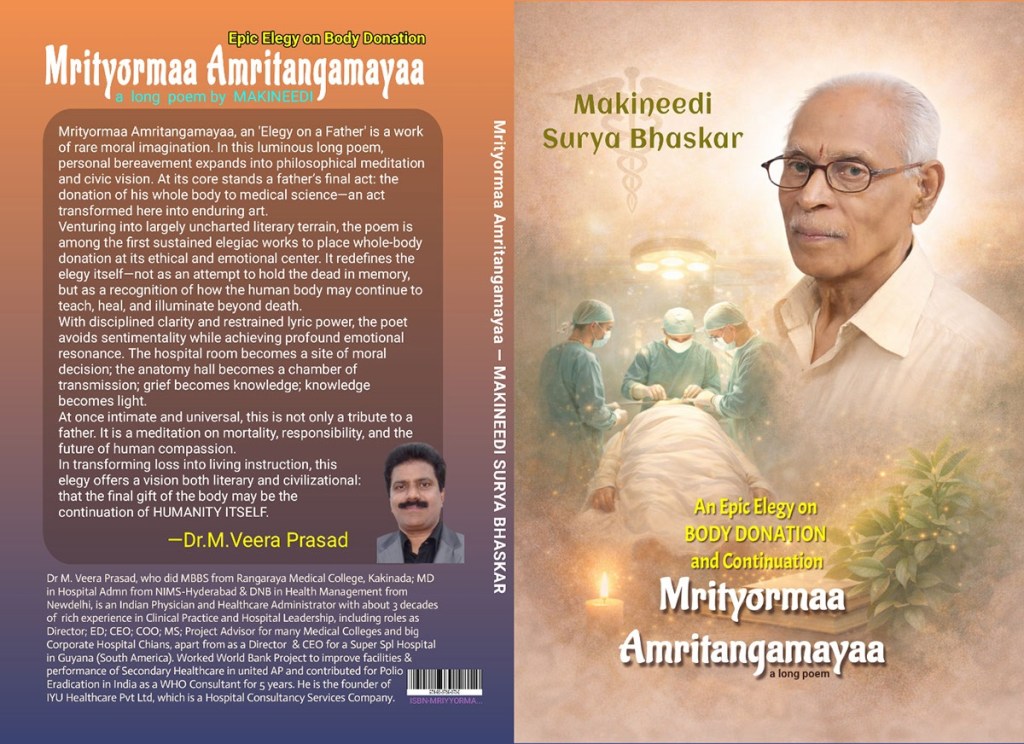
The decision taken by the father of Mr. Surya Bhaskar following death, to donate his body to Rangaraya Medical College gave shape to an immortal poem of remembrance by the son, the author. Some of the most delicate and deeply felt emotions and psychological experiences have been woven into this book with extraordinary warmth.
The fact that Mr. Makineedi’s father donated his body, thereby transforming the earth itself into an immortal abode of ultimate sacrifice through his existence beyond death is one of its distinctive features. Yet another remarkable aspect is that the Author ‘s personal grief did not end merely in social utility. His Father’s body became an instrument through which another generation of medical students could learn human anatomy at its finest detail. The most noble consequence is the poet’s inner journey.
Revered poet Surya Bhaskar however travels much farther. He is conscious that, the ‘DehDan’- volunteer donation of body after death by his father will impart knowledge which forms basis for their understanding of human body thus imparts the greatest skill of healing to the future generations of Doctors.They, in turn will serve the society and humanity at large by giving health and life ailing individuals and relief to their families.It is written at the outset of Anatomy dissection hall that, ” The Dead teach the Living”. It is a fact indeed and every medical student owes this learning to be utilised for the good health of society at large.
Human anatomy is one of the most remarkable fields of biological science. Through this book, Makineedi Surya Bhaskar crosses the boundaries between the physician and human being, enters the realm of humaneness and spirituality taking the reader along with him with grace. In the process of capturing his deep emotions within this poem some rare and intensely complex feelings experienced only on exceptional occasions, the writer moves from the physical world into the metaphysical plane. He offers to the readers the anguish of losing his father as a fountain of ‘karuna rasa’—the essence of compassion.
Only a talented surgeon and a scholar of human anatomy who has spent years continuously acquiring knowledge through the dual disciplines of study and experiment can pick up certain details. These were translated into a beautiful and epochmaking long poem by Sri Surya Bhaskar with utmost skill. He has transformed scientific understanding into remarkable poems in this book. Each poem, written in simple English, yet carrying profound meaning, holds the reader by hand and leads them into another world.
The Poet has expressed with bizarre poignancy the human intellect and emotions unfolding outward in a spiralling layer upon layer.The writer tells us that, by donating his body his father, received the highest form of honor by becoming a living truth revealed through the training of medical students as they prepare themselves to become doctors of posterity. Though he has written more than a hundred books and walked for decades along the path of devotion to art, Mr. Surya Bhaskar says that he could never fully comprehend his father’s farsighted ness, selfless mental strength and profound spirit of dedication by this act of ‘Dehdan’.
By the way, who can establish the highest moral values?
Those disciplined?
Those who practise selflessness?
Those who walk the path of non-violence?
The writer says that, beyond all these, it is those who understand the recurring truth of life and death capable of surrendering themselves to the progeny of one generation to reveal the mysteries of the human body.
In his poem, the Poet asks..
“Do they know?
That those hands once lifted a child?
How many journeys that body had undertaken?
Every muscle is a silent
symbol of the artistry of bodily structure.
Every muscle fibre
is a teacher explaining how the process called movement takes place.
Not merely as an imagined idea, but through a revelation of existence,
it teaches that this is the true, essential form
of life and living.”
Thus, he says, his father came to perform a sacred act by laying open every detail of blood vessels, nerves and tissue structures that a first-year medical student learns in the anatomy dissection hall. No artificial intelligence nor a simulator can ever replace this learning!
“Now I understand.
Truly, completely..
While alive, the desire for life,
in the lifeless coldness, the memory,
and through body donation keep humanity warm..”
These lines by the poet divulge how beautifully even things visible to the eye can be made eternal. Every student who enters a medical college takes this, does he not? as the first step on the journey towards becoming a doctor and help countless people move from illness to health, from the threshold of death towards life! The writer repeatedly thrills at this thought within himself.
“Within myself, I wonder..
After all,
do they realise that the first lesson they learned
was upon your body itself?
Will that memory ever fade?
Then I understand:
Even if they forget you,
their skill will remember you forever.”
This is a sacred act. Morals and sacrifice may be a belief belonging to the practice of religion. But proficiency is not, is it? It is a wonder that the body of one who has passed away teach the first lessons of medicine to an entire generation of doctors. This revelation of truth lifts the reader’s mind to the highest peak of Human dignity.
“The student rushing out
from the anatomy classroom –
the path of life unfolding before him –
appears in my mind.
That scene consoles me.
Your death
teaches me another lesson.
It is
not merely the structure of tissues.
It is the value hidden within body donation.”
While reading this book, we experience, time and again an ethereal journey from life towards death, and from death towards the revelation of an eternal truth. We are filled with wonder: Can this human body of flesh and blood achieve such a supreme ideal of selflessness—something beyond the reach of the senses, yet capable of such profound significance in human experience? This literary work places Makineedi Surya Bhaskar among eminent poets such as Thomas Gray, Shelley, Lord Tennyson and Allen Ginsberg. Alongside their prolonged lamentations, these writers touched upon the transience of human life and conveyed to humanity the burden of the world of sorrow. Sharing their personal grief, readers are moved by emotions of profound resonance. But Mr. Surya Bhaskar, through this work, has attained a deeper maturity of mind and conveyed to the reader the inner meaning of his father’s words, “Warm it once again.” In doing so, he has enabled the reader to travel towards the ultimate destination of a search for the truth of human existence. For this, he deserves our appreciation.
“On the path of my memory a bend,
but never a river that knows exhaustion –
memories, knowledge and humanity,
the confluence of three sacred rivers.
Instruction born of death,
Light emerging from the darkness of sorrow,
a living song rising from silence –
that is Mrityormaa Amritamgamaya.”
The explanation offered by the author here is a truth that touches every heart.
Written in English, the language possesses such simplicity that it can be easily understood both by those studied in the English medium and by those whose mother tongue is Telugu.
As a gift to medical students, and as a work that creates awareness for the cause of donating one’s body after death, this is a work worthy of appreciation. May the mankind realise that the torch of kindness and sacrifice be handed over to coming generations.
***
Poet: Makineedi Surya Bhaskar
Publisher: Soumya Publications, Kakinada
Pages: 136
Price: ₹ 150/-
For Copies:
Makineedi Surya Bhaskar
8-14-45, Vriddhi Varadaraja Apartments,
Red Cross Street, Gandhinagar,
Kakinada 533004
Ph: 8985217627
Email: makineedi.writer@gmail.com