



The Real Socialist is Ravana
Not Ramayana.. but Ravanayana
A Successful Propaganda Campaign
The Gen Z trend is now sweeping the country. Among the various forms of media that influence this generation, cinema is undoubtedly one of the most powerful.
A few years ago, a film titled KALKI was released simultaneously in several Indian languages. The entire story of KALKI is set in a period that takes place a hundred years or so in the future. Into this futuristic narrative, the filmmakers bring in two or three characters from the Mahabharata era, which dates back 5,000 years, and connect them to the events of the future.
Some may call this cinematic freedom. There is no problem with that. But who gave filmmakers the freedom to alter the personalities of characters from the Mahabharata, an epic regarded as one of India’s greatest sacred texts and often referred to as the Fifth Veda?
During the Kurukshetra war, Arjuna shoots an arrow at Karna’s chariot, pushing it back by six feet. Karna, in return, shoots an arrow at Arjuna’s chariot, pushing it back by only two feet. Arjuna smugly asserts that his chariot has retreated just two feet, but Karna’s chariot has retreated much farther.
Krishna’s character ridicules Arjuna, saying, in effect, “It is only because I am standing with you that your chariot has moved back by just two feet. Otherwise, what chance would you have against Karna?”
This single scene became a trending topic among Gen Z and generated extensive discussion.
This is a narrative invented by the director and writers to turn Karna, who was responsible for much of the destruction and mass killing in the Mahabharata, into a hero.
What impression will this film leave on the present generation? They will conclude that Arjuna was incompetent and that Karna was a great and humanitarian figure. Twenty years from now, members of this generation may pass on precisely these lessons to the next generation. As time passes, the real story might be forgotten, and the films’ fictional version might be treated as true history.
A striking example of this phenomenon is the making of N. T. Rama Rao’s films in the 1970s, in which Ravana and Duryodhana were portrayed as heroes.
In 1977, Daana Veera Soora Karna, made by the combination of Kondaveeti Venkatakavi and N. T. Rama Rao, was released. It portrayed Karna and Duryodhana as great personalities while depicting the Pandavas as unrighteous.
This film, released nearly fifty years ago, had a powerful influence on children and young people who were then around 15–20 years old. Even today, it is unfortunate that people continue to celebrate by repeating its dialogues.
Filmmakers depicted Karna and Duryodhana as socialists, communists, and champions of egalitarianism.
The irony is that the same N. T. Rama Rao had, during the 1960s, acted in several films based faithfully on the narratives of the Ramayana, Mahabharata and Bhagavata Purana. But by the 1970s, the situation had changed completely.
Marxist historians and Dravidian movement activists, who sought to portray antagonists as heroes, recognised cinema as an extremely influential medium and chose it as an instrument for advancing their ideas. That trend continues even today.
Some time ago, a film titled Adipurush was released. It is difficult to say whether even the people who made that film understood the story they were attempting to portray. People referred to it as Rama’s story, yet it was not truly the Ramayana. The characters were supposedly Rama and Sita, but they did not resemble the Rama and Sita familiar to us.
That was the film. And whenever anyone raised objections, the answer was invariably: “Cinematic freedom!”
Does cinematic freedom mean misleading people about the personalities of figures who have lived in the collective consciousness of Indians for thousands of years?
Now another new film almost like an ideological clone of earlier dharma subversive films has arrived. It too is called the Ramayana. Everyone may find pleasure in their own peculiar interests. But when it comes to historical and epic figures, if filmmakers distort Puranic charachter personalities according to their own whims and fancies, produce something with spectacular graphics and VFX technology, and release it before the public, it would be a mistake to assume that the result will not become another propaganda film like Daana Veera Soora Karna.
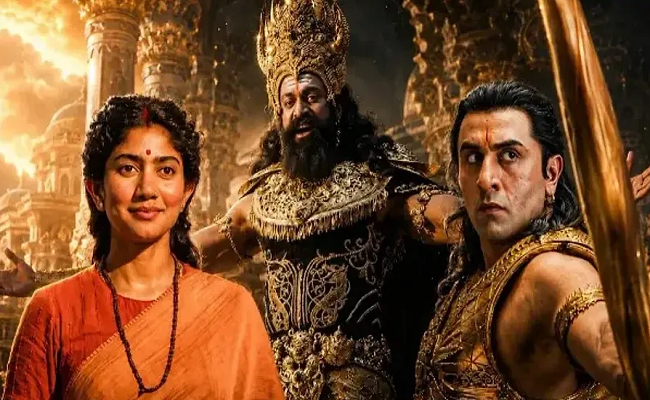
The recently released Ramayana (2026) is precisely such a propaganda film.
Perhaps one should feel relieved that this Ramayana is less terrible than Adipurush, which was an exceptionally poor film. I am not discussing the cinematography, graphics or costumes of this film. My discussion is exclusively about its narrative. That is what deserves serious scrutiny.
Otherwise, in the future, this fictional narrative may become accepted as genuine history. Twenty-five years from now, young people who have been influenced by this film today may propagate its version as the truth.
The film opens with a war between the Devas and the Danavas. The war is led by Kaikasi, Ravana’s mother. The story of Kaikasi leading a battle against the Devas is an example of the director’s extraordinary and unexpected creative imagination.
Along with Kaikasi, her father Mali (originally, her father was Sumali) also participates in the battle. Indra arrives to fight them, supported by Vishnu, and defeats them. The Devas seize Lanka and crown Kubera as its ruler.
This is the introductory scene of the film.
In Valmiki’s Ramayana, Uttara Kanda, Sargas 4–7, we find the account of these Rakshasas. Vishnu himself directly fights the Rakshasas who were living in Lanka, a city already constructed by Vishwakarma, and tormenting its inhabitants. Indra does not lead the battle.
Vishnu defeats them and drives them into Rasatala, the netherworld, so that they cannot continue troubling the people of the earth. However, in the film, Kaikasi’s father is killed.
Lanka is subsequently left vacant. Much later, Vishravas, the father of Kubera, sends his son to Lanka. Kubera is Ravana’s half-brother.
Sumali sees Kubera and his prosperity. He therefore uses his daughter Kaikasi to attract Vishravas, win his affection and marry him. Ravana, Kumbhakarna and the others are born from this union.
But in the film, Kaikasi is shown displaying extraordinary military skills. The film depicts Indra as a villain who unjustly snatches Lanka from them.
The Uttara Kanda portrays Ravana’s birth in a frightening manner. From the moment they are born, Ravana and Kumbhakarna grow into extremely terrifying personalities.
Seeing Kubera’s immense wealth and luxurious life, Kaikasi wants Ravana to seize all his brother’s riches so that she and her sons can enjoy the same prosperity. Therefore, she instructs Ravana to take control of Lanka.
Ravana sends a messenger to Kubera, ordering him to surrender Lanka. Vishravas, Kubera’s father, explains Ravana’s wicked intentions and advises Kubera to abandon Lanka.
Kubera simply leaves Lanka.
But in this film, everything is presented in reverse.
The film portrays Ravana as an extremely gentle and virtuous person, devoted exclusively to music and the sciences. Kaikasi deliberately approaches him and provokes him, saying their Rakshasa community has suffered a grave injustice and that he must fight for their rights.
The film depicts the Rakshasas in Rasatala as living miserable lives, like insects and worms. They suffer from hunger and thirst, die prematurely, and live in unbearable conditions.
Many claim Vishnu bears responsibility for all their suffering. Kaikasi tells Ravana that he must avenge these injustices.
Until then, Ravana has been playing his veena. But the moment he hears these words, he abandons the instrument, plunges into the water, and sets out on a journey.
He walks across desert sand dunes, sweating profusely. He overcomes hunger, cold, snakes and wild animals. He enters a dense and inaccessible forest, stands on one leg at the edge of a mountain and performs severe penance.
He obtains a boon from Brahma, returns to Lanka, defeats Kubera and seizes the kingdom.
Unable to tolerate the domination of the Devas, Ravana stages a revolt, much like the anti-hero protagonist of the film KGF. He defeats Kubera, takes possession of Lanka and the Pushpaka Vimana, and establishes socialism.
His mother Kaikasi then begins calling him Ravana instead of Dashagriva.
Ravana proceeds to deliver a lecture on socialism. He speaks about establishing an egalitarian society and proclaims that the king and the people are one and the same.
After marriage, he conquers the three worlds and convenes a royal assembly.
During this gathering, Shurpanakha’s husband, Vidyujjihva, insults a female attendant. Ravana becomes furious. Ravana reproaches Vidyujjihva on his treatment of women and challenges him to tell the difference between the bedroom and the royal court.
Ravana then deliberately provokes Vidyujjihva and has him killed.
Filmmakers crafted this episode to establish that Ravana was not a womaniser.
In the original narrative, Vidyujjihva, one of the Kalakeyas, dies when Ravana kills them during his military conquests. The filmmakers have brought this character into this particular episode to create propaganda portraying Ravana as a virtuous man who had no attraction towards women.
After her husband’s death, Ravana sends Shurpanakha to Janasthana, promising that he will arrange another marriage for her if she finds someone suitable, like in the film God Father, in which Michael Carleone kills the husband of his sister and sends her away to choose a new husband!
The Story of Shurpanakha
Now comes the story of Shurpanakha.
Viewers see Shurpanakha as exceptionally beautiful, and the film portrays Sita as merely ordinary-looking.
Shurpanakha arrives at Janasthana, saying that her brother has sent her there. She stays with Khara and Dushana, who are treated almost like brothers to her.
According to this film, Shurpanakha is an extremely good woman. She approaches Rama, who is living in Panchavati, and engages him in a very polite conversation.
Consider the following exchange between them:
Shurpanakha: Why have you entered our kingdom? Why did you kill our Asuras as soon as you arrived?
Rama: We have come here seeking shelter as part of our forest exile. We killed your Asuras only because they attacked us first.
Shurpanakha: You don’t look like ascetics.
Rama: That is true. We are the sons of King Dasharatha.
Shurpanakha: Then why are you staying here? Come to our royal palace. Accept our hospitality.
Rama: Thank you, Princess. We prefer to stay here.
Thus, Shurpanakha speaks very courteously to Rama and offers him royal hospitality.
Immediately afterwards, consider the dialogue put into Sita’s mouth by the director:
Sita: She is attracted to you.
Rama: How do you know?
Sita: Only a woman can understand what is in another woman’s mind. (Laughs.)
The following day, Shurpanakha returns to Panchavati and asks Rama to marry her.
Rama refuses, telling her that he will not marry her.
Sita witnesses the incident and subsequently speaks to Rama.
Sita: What were you discussing with that princess?
Rama: She asked me to marry her. She even offered to make me king.
Sita: Then why don’t you become her king?
Rama: If I become her king, who will serve you?
Sita: She is extraordinarily beautiful. Please think about it once.
Rama: When the rays of the Sun itself are available, what need is there for fireflies?
The next day, Shurpanakha disguises herself as Sita and approaches Rama, attempting to win him over. Sita and Lakshmana witness this and feel astonished.
Lakshmana cuts off her nose and ears.
Sita becomes angry. She questions Lakshmana, asking what terrible offence Shurpanakha had committed to deserve such punishment. She expresses concern that cutting off a woman’s nose could have serious consequences.
Repeatedly, I have tried to understand how this lengthy sequence should be interpreted, yet I cannot make sense of it.
Portraying Shurpanakha as such an extraordinarily virtuous person is itself strange. What is the point of making Sita deliver these kinds of dialogues?
Is it not outrageous?
The story presents Shurpanakha as a good and beautiful woman, and Sita casually suggests she remarry.
What superb scripting!
Does the Indian civilisation revere the lives of Sita and Rama, making such conversations inappropriate?
Even in Valmiki’s Ramayana, does Sita ever express such thoughts?
On what basis, then, have the filmmakers attempted to destroy Sita’s personality in this manner?
The Portrayal of Sita
Sita’s character in this film is extremely peculiar.
One can learn from the actress playing Sita how to perform without displaying even the slightest emotion or expression in any scene.
During the Swayamvara, when Rama breaks Shiva’s bow, great poets have beautifully described the emotions of Sita and Rama.
The Telugu poet describes the scene in these words:
“His gaze did not fall upon Janaki in vain; nor did his effort with the bow of Shiva go in vain.
Sita bowed her head, her face turned downward; the bow broke in the middle like a sugarcane stalk.”
What an extraordinary scene!
With today’s technology, filmmakers could have portrayed such a moment more beautifully.
But what do we actually see?
He arrives, lifts the bow and breaks it. Sita simply stands there watching, completely expressionless.
Is this what creativity means?
The wedding of Sita and Rama is an ideal for the entire universe, something worthy of emulation. The film’s presentation of a sacred wedding sequence in a lifeless manner, as if the makers do not want an ideal marriage, but, prefer something else. It astonishes viewers.
After arriving at her husband’s home, Sita begins teaching women martial arts. Sita and Martial arts do not go together. There are many instances in Ramayana, when, Sita appears helpless and vulnerable, never like a martial arts Master.
Even after Shurpanakha faced humiliation in the forest, when the Rakshasas led by Khara and Dushana attack Rama, Sita also takes up a sword and fights alongside Rama and Lakshmana.
The film depicts all three of them fighting together to destroy the Asuras. This gives the film more of a cartoon like feel than the most respected and revered Ramayana based film.
The filmmakers show Sita as crucial to the battle, making it seem Rama would have fallen to Khara and Dushana without her support, just as Arjuna was depicted as completely dependent on Lord Krishna. Maligning most respected and treating great warriors as ineffective seems to be the new normal for Hindu mythology based film makers.
Later, when Rama goes in pursuit of the golden deer, Sita hears what appears to be Rama’s voice crying, “Lakshmana, protect me!”
She asks Lakshmana to go and help Rama. When he refuses, she herself attempts to take a sword and go.
The filmmakers have explained that they drew inspiration from the Adbhuta Ramayana, in which Sita appears as a manifestation of divine power.
However, in Valmiki’s Ramayana, when Rama goes to fight Khara and Dushana, he places Sita inside a cave and asks Lakshmana to guard her. He goes alone and kills 14,000 Rakshasas.
Valmiki describes how Rama bends his bow into a circular shape and releases dozens of arrows at a time.
Poor Rama! In this film, he appears to be dependent on others.
Even Lakshmana makes sarcastic remarks about Rama. He tells him:
“If only you had a little cunning in you, we could have avoided this exile.”
The Abduction of Sita
In this film, when Ravana arrives to abduct Sita, she becomes suspicious of him.
She challenges him:
“If you are truly an ascetic, recite a particular mantra—the 120th mantra of the tenth Mandala of the Rig Veda.”
Ravana immediately shouts:
“Hey! How dare you question me?”
He then recites the mantra.
Sita feels impressed and says:
“Great man, wait! Wait!”
She runs after him, trying to offer him some roots and fruits.
Ravana even asks her:
“Has your arrogance been subdued now?”
It is difficult to understand where the writers of this film obtained such extraordinary creative ideas.
When Sita travels to Lanka in the Pushpaka Vimana, there is not the slightest emotional expression on her face. She remains perfectly calm and expressionless, simply looking at the surroundings below.
When Jatayu arrives and challenges Ravana, a fierce battle takes place between them. Even when Jatayu’s wing is severed and he falls to the ground, Sita displays no emotion whatsoever.
Perhaps acting without expressing any emotion is also a great art!
The interesting part is that after Jatayu’s death, Sita delivers a dialogue:
“Do not imagine that your revenge will be fulfilled merely because you have abducted me.”
Through this single dialogue, the director makes Sita herself explicitly establish that Ravana’s motive is revenge and not lust.
The Portrayal of Rama
Coming to Rama’s character, the director appears to have made a deliberate attempt from the beginning to portray him as a narrow-minded person.
As Rama grows older, the director introduces elements of the Buddha’s personality into him.
Rama becomes deeply disturbed after witnessing the suffering that is widespread in society.
He questions his father about the reasons behind endless human suffering, extreme poverty and the enormous inequalities between people who possess excessive wealth and those who have almost nothing.
Through Rama, the director makes him articulate what essentially amount to simplistic communist theories.
Later, after Rama grows up, the director creates one or two scenes in which he appears to look down upon his younger brother Bharata and treat him with disdain.
When Vishwamitra arrives to take Rama with him, Rama himself comes forward and declares that he is ready to accompany him.
Immediately afterwards, Bharata approaches and says:
“Brother, I too would like to accompany you.”
Rama refuses, saying:
“No, no. You must stay in Ayodhya and look after the kingdom.”
But when Lakshmana arrives immediately afterwards and says that he too wants to accompany Rama, Rama readily agrees.
The filmmakers then introduce dialogue through Manthara, suggesting that Rama has deliberately discriminated against Bharata by refusing to take him along while readily accepting Lakshmana.
After Bharata visits Chitrakoota, takes Rama’s sandals and returns to Ayodhya, the film apparently suggests that Rama leaves Chitrakoota and goes to Panchavati because he is afraid Bharata might return there.
Salutations to this kind of creativity!
Even Lakshmana makes sarcastic remarks about Bharata.
When Rama and Lakshmana go to protect Vishwamitra’s sacrificial ritual, the only demons shown obstructing the ritual are Tataka and Subahu.
But what happened to Maricha?
Rama kills only Tataka and Subahu. Why has the important character of Maricha been omitted? What was gained or lost by leaving him out?
After the protection of the sacrifice, Vishwamitra seats Rama and Lakshmana before him. He gives divine weapons exclusively to Rama and leaves Lakshmana out.
It is difficult to understand the logic behind this.
One could go on describing such things. In fact, each individual scene in this film could probably become the subject of an entire separate film!
The Real Message of the Film
Ultimately, these are the points that the director and writers appear to want to communicate through this film:
1. Ravana was a great man, a Lohia-inspired socialist who aspired to establish an egalitarian society.
2. He was a person who deeply respected women. Ravana abducted Sita solely to avenge his sister’s humiliation, with no other purpose guiding him.
3. Rama was not a good person because he rejected Shurpanakha’s love, despite her extraordinary beauty.
4. Sita was essential to Rama’s victories in battle. Without her assistance, Rama would have been defeated.
This is a cleverly packaged, lavishly produced anti-Ramayana propaganda film.
By the time people understand what has happened, an entire generation will have passed.
In the meantime, Ravana will have become firmly established in public imagination as a great champion of social justice, while Rama will have been transformed into a villain symbolising injustice.
That is precisely their objective.
The making of this film is just one step towards achieving that objective.
Before winding up, I would like to make one thing clear.. For us, those who believe in Bharateeya Dharma, Ramayana or Maha Bharata are not cartoon strips or VFX extravaganzas. When we go to see a film based on these epics, we go to watvh the film to learn values, not to be thrillied to the core or to be filled with venemous misinterpretations. We would like to see just the plain Ramayana with eternal values…that is the secret of success, or rather, that is the only secret of success, and that is what this VFX Ramayana lacks, the basic fundamental values and raw human emotions.


కోవెల సుప్రసన్నాచార్య గారి తనయుడు జర్నలిస్టు కోవెల సంతోష్ కుమార్. చక్కని రచయిత. దేవ రహస్యం, విలయవిన్యాసం, రామం భజే శ్యామలం, కల్లోల భారతం వంటి పుస్తకాలు వెలువరించారు.