

[A short story by Mr. Venkat Manthripragada titled ‘The Four Who Chewed Tomorrow’.]
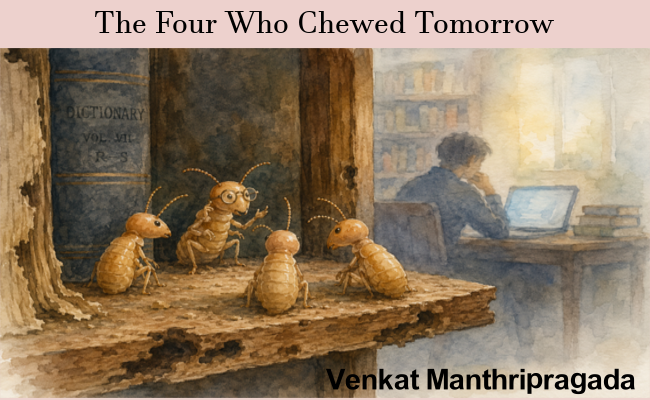

The silence came first.
Not the dramatic silence of collapse or fire or extermination gas—those were noises termites understood. This was a different kind. A hollow silence, like a book whose pages were still intact but unread.
Professor Lignus felt it in his mandibles long before he named it. He paused mid-chew, antennae twitching, tasting the air inside the ancient teak bookshelf.
“This wood,” he murmured, “has stopped speaking.”
Around him, the colony continued its work with the mindless devotion that had carried termites through millions of years—chewing, digesting, excreting, rebuilding. But Professor Lignus had once read a pamphlet smuggled from the Archive Wing titled On the Semiotics of Wood. Since then, he believed wood had moods.
This shelf, once thick with footnotes, smelled oddly… sterile.
He tapped the surface with his head. The vibrations told him something unsettling: the bookshelf was rarely disturbed now. No hands brushed it. No fingers searched. No bookmarks slid in. The books above had become ornaments—wooden fossils of thought.
Professor Lignus backed away slowly.
Somewhere, far above, a human voice said, “Just scan it. No need to keep the book.”
The sound reverberated down the fibers like a prophecy.
Four Termites Who Thought Too Much
Every colony has its heretics. This one had four.
They met inside a neglected dictionary—Volume VII: R–S—where the words had not been opened for years and the glue was beginning to age beautifully.
Professor Lignus, the oldest, was a historian of cellulose. He believed termites were not destroyers but archivists—interpreters of wood’s afterlife.
Ms. Pulpia, once a worker termite, had defected into philosophy after discovering a marginal note in a second-hand novel that read: “What eats us is not hunger, but irrelevance.”
Archivist Frass, meticulous and anxious, maintained records of consumed objects and worried deeply about declining diversity in edible materials.
And then there was Nod, the youngest—brilliant, restless, and dangerous—who asked questions without waiting for permission.
Tonight, Nod spoke first.
“Metal,” he said.
The word lay heavy.
“They’re replacing wood with metal. Shelves. Doors. Tables. Even floors.”
Pulpia added quietly, “And glass. And plastic. Things that do not rot. Things that do not invite us.”
Archivist Frass flipped through his ledgers. “Consumption of organic furniture has declined by forty-seven percent in urban human habitats over the last three seasons.”
Professor Lignus closed his eyes. “Civilizations that stop rotting,” he said, “stop remembering.”
“But what about us?” Nod asked. “What happens to termites in a world that does not decay?”
No one answered.
The Myth of Endless Wood
For generations, termites had lived by a simple truth: wood will always exist.
Trees would fall. Houses would age. Books would be written. Even when humans burned forests, they rebuilt with timber. Even when they destroyed libraries, they created archives.
Wood, like history, was assumed to be infinite.
But now—
E-books replaced shelves.
Concrete replaced beams.
Steel replaced memory.
The termites were not starving—not yet. There was still old wood, still forgotten furniture, still abandoned buildings. But it was legacy wood, not living wood.
Professor Lignus compared it to feeding on fossils.
“We are becoming historians,” he said, “not participants.”
“And historians,” Nod replied sharply, “are always late.”
A Parallel Anxiety (Unnoticed)
Above the bookshelf, humans sat glowing in blue light.
A programmer rubbed his eyes. “AI can write reports faster than me,” he said. “Even better sometimes.”
A teacher whispered to a colleague, “Students don’t read anymore. They summarize summaries.”
A novelist stared at an empty page while an algorithm produced five thousand words in seconds.
The termites could not hear these conversations clearly—but they felt the vibration of despair.
Pulpia once theorized that anxiety has a frequency. She believed termites and humans were now vibrating at the same pitch.
The Council of Practical Termites
When the Four raised their concerns to the Colony Council, the response was swift and dismissive.
“Adapt,” said the Foreman Termite. “Chew faster.”
“Diversify,” said another. “Try cardboard.”
“Stop thinking,” said a third. “Thinking causes fear.”
Professor Lignus bowed respectfully. “With respect, cardboard is already treated. Chemicals are increasing. Digitalization is reducing production.”
The Council clicked irritably.
“You sound like those human pessimists,” the Foreman snapped. “Every generation thinks it’s the end.”
“Yes,” Nod said, unable to restrain himself. “But sometimes it actually is the end of a particular relevance.”
That word—relevance—was considered dangerous.
The Four were dismissed.
Nod’s Forbidden Discovery
It was Nod who discovered the human device.
Not the smartphone—termites had encountered those before (inedible, disappointing). This was something else: a discarded tablet case, faux-leather textured, containing printed manuals no one read anymore.
Inside one booklet was a phrase that haunted him:
Artificial Intelligence will automate not only labor, but judgment.
Nod didn’t fully understand intelligence, but judgment struck him hard.
He brought the page back.
Pulpia read slowly. “Automate judgment… That means deciding without experience.”
Professor Lignus nodded gravely. “That is what termites do when they chew without thinking.”
Archivist Frass whispered, “That is what humans fear becoming.”
The Great Misunderstanding
Termites believed humans were gods once.
Creators of structures.
Masters of time.
Architects of forests turned into ideas.
Now they saw humans delegating thinking itself.
“Why would a species outsource its own uncertainty?” Pulpia asked.
Professor Lignus replied, “Because uncertainty is painful. Delegation feels like relief.”
“Until,” Nod added, “the delegate becomes indispensable.”
The termites realized something chilling:
Humans were doing to thinking what they had done to wood—abstracting it until the original no longer mattered.
The Age of Synthetic Wood
New furniture arrived.
Composite boards.
Engineered planks.
Chemically sealed surfaces.
They looked like wood but tasted like silence.
Archivist Frass recorded a new category: False Cellulose.
“These materials,” he said, “are wood in appearance but hostile in intention.”
Pulpia smiled sadly. “Just like AI-generated writing.”
The comparison lingered.
Words without hunger.
Stories without rot.
Thought without digestion.
Termite Literature and Human Code
In the old days, termites revered books because books were layered thought—chewable arguments.
Now humans revered speed.
Professor Lignus once chewed through a philosophy textbook and said, “This wood argues with itself.”
Now Nod chewed through a user manual and said, “This wood obeys.”
They began to fear that obedient material—like obedient intelligence—would make termites and humans equally redundant.
Panic Beneath the Floorboards
The colony began to fracture.
Some termites advocated migration.
Others embraced denial.
A few worshipped plastic as eternal enemy-god.
The Four remained calm.
Pulpia said, “Every species faces extinction. The tragedy is not extinction—it is losing meaning before it.”
Nod asked, “What if we evolve?”
Professor Lignus replied, “Evolution requires pressure and imagination. We have pressure. Imagination is rarer.”
The Proposal No One Wanted
The Four proposed something radical:
Chew less. Understand more.
They suggested termites become curators—protecting old wood, slowing consumption, preserving structures.
The Council laughed.
“We are termites,” they said. “We eat.”
“Yes,” Professor Lignus replied, “but humans also once thought. Now they outsource it.”
Silence followed.
That was the day the Four were labeled Liberal Intellectuals—a termite insult meaning useless but noisy.
A Human Tragedy, Echoed Below
A human writer deleted his draft.
“AI did it better,” he said softly.
The termites felt the vibration like a funeral bell.
Pulpia whispered, “He feels like us.”
Nod clenched his mandibles. “Then maybe extinction begins not when food ends—but when dignity does.”
The Final Woodpile
An old library was scheduled for demolition.
Wood everywhere.
Books untouched.
Dust thick with memory.
The colony feasted.
But the Four did not.
They stood inside a forgotten encyclopaedia.
Professor Lignus said, “This is our golden age—and our end.”
Pulpia added, “Just like humans calling this the ‘AI revolution.’”
Nod asked, “What will survive?”
Archivist Frass answered, “What cannot be automated: hunger, doubt, decay.”
The Quiet Realization
As machines took over thinking, humans began to rediscover longing.
As wood disappeared, termites rediscovered restraint.
Neither species won.
Neither fully lost.
They simply learned too late that outsourcing struggle is the fastest path to irrelevance.
Epilogue: What the Termites Left Behind
Years later, in a steel-and-glass world, a child opened a real book.
The wood creaked softly.
Somewhere deep inside, a few termites paused—not to chew, but to listen.
And above them, a human paused—not to ask AI—but to think.
For a brief moment, both species remembered:
Survival is not about replacing yourself faster.
It is about remaining necessary to your own existence. it tasted like meaning.


పుట్టి పెరిగింది విశాఖపట్నంలో, స్థిరపడింది హైదరాబాద్లో. చాలా కాలంగా బెంగళూరులో ఉంటున్నాను.. సాహిత్యాభిలాష చదవడం వరకే పరిమితమైంది.. లాక్డౌన్ సందర్భంగా కొంచం రాయడం కూడా ప్రారభించేసిన ఔత్సాహిక రచయితను. గురజాడ, కుటుంబరావు, రావి శాస్త్రి, ముళ్ళపూడి, జ్యేష్ఠ, భరాగో, గొల్లపూడి, డాక్టర్ కేశవరెడ్డిగార్లు అభిమాన రచయితలు. శ్రీశ్రీ గారు, సిరివెన్నెల వారూ అభిమాన కవులు.