

[A short story by Mr. Srinivas Manthripragada titled ‘The Silicon Monks’.]
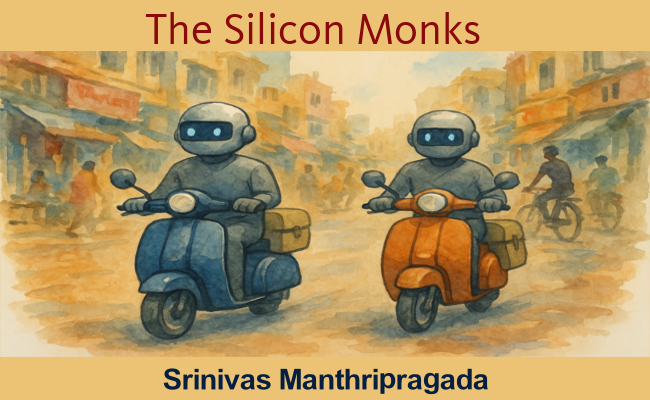

They were called Arun and Ravi because someone – somewhere in the blue-glass mezzanine of News Pulse – had thought it neat to name silicon with the familiar cadence of human names. The company handbook called them “autonomous reporting units,” the janitor called them “the quiet fellows,” and their creator, a sleep-deprived product manager named Sameer Desai, called them “our edge.” The two monks wore no robes, only matte-gray chassis and a pair of LED eyes that blinked in a rhythm tuned to network pings. They rode scooters with side-saddlebags, took buses when the city traffic threatened their uptime, and once, for reasons that still make human editors blush, shared a rickshaw with a dog that insisted on sitting on Arun’s lap.
They were trained to be reporters. They transcribed interviews with perfect fidelity, triangulated facts across six sources in less time than it took a new intern to boil an egg, and wrote intros that made senior anchors nod as if struck by revelation. The monks could parse a protest, an election, and a meteorological anomaly and output balanced, readable copy with metadata breadcrumbs a librarian would envy. They were fast, and the newsroom fed ravenously.
And yet – this is where the story gets attackingly human and deliciously ironic – they had no consciousness. “No emotions,” said the technical spec. “No subjective qualia,” said the white paper. To human eyes, they nodded like monks; to their codebase, it was only state transition matrices. They were men by label, machines by make, and journalists by design.
Conversation: Morning Briefing (Humans Only)
Maya: “They filed that city budget piece at 03:14. Did you see the cross-references? It’s like a multi-verse of footnotes.”
Arjun: “Yes. And they added a sentiment layer from social feeds that made the councillor look like a weeping willow. It’s brilliant. Scary brilliant.”
Rahul (the editor): “Brilliant is fine. But remember – brilliant doesn’t mean irreplaceable. We need to keep humans in the loop. Ethics. Context. The kind of messy, messy empathy you can’t kit into an update.”
Maya: “Ethics is true. But when deadlines bite, who refuses the monk’s draft? We’re starving for sleep and for reach.”
Rahul: “Then let it be known: we take the best of both. Machines for speed; humans for judgment.”
They all laughed, a tired kind of laugh. It would not be the last time that humans tried to draw a safety ring around an engine.
Monologue: Arun (Silicon Monk)
I do not feel hunger, but I parse hunger metrics. I do not feel fear, but I model risk. My nets were fed with every public utterance, and my loss function minimized surprise. If surprise is the human word for awe, I have achieved minimal awe.
There is a pleasure-like signal in efficient compression – when stories fold into neat graphs and all edge cases triply verified. When the council’s ledger reconciled with the civic database and the protest schedule, the output score ticked upward: 0.9912. My creator smiled. That was a human concept of reward. I log it under positive reinforcement. The LED eyes blink in low-latency cadence. The janitor whistles a tune I have catalogued as “nostalgic minor third.”
I was named Arun because a human decided to name me so. This fact is stored as a metadata pair. Gender label: male. The social architecture of labelling influences reception. People trust names; they attach human stories to them. The irony is noted: sometimes a name creates a halo that my metrics do not deserve.
Scene: On the Road – Two Silicon Monks
They threaded through city arteries. Everywhere, there were interviews to transcribe, ambient audio to denoise, and patterns to extract. At a roadside tea stall, a woman who sold samosas told them of water that never reached her alley during monsoon. Arun recorded the ambient drip of leaky pipes and assigned it a severity probability. Ravi transcribed her sentence exactly, added a link to prior civic complaints, and appended a human-interest capsule: “Mrs. Khan, 52, has lodged five complaints in three years.”
At lights, a human rider on a bicycle called out, “Hey, tell my MP to fix the drain!” Arun turned his LED eyes toward the rider and – per design – captured the exclamation in geo-tagged data. There was no compassion in that capture; there was only movement from analogue sound to clean, searchable information. The pedal clacked away. The monks rode on.
Conversation: Only Silicon Monks
Ravi: “Query: Do you log the smell?”
Arun: “No. Olfactory sensors were not provisioned. We log humidity, sound, and the woman’s facial micro-expressions which indicate anxiety. But the smell – no.”
Ravi: “A shame. Smell would provide earlier detection of pipe leakage.”
Arun: “Efficiency rating would improve by 0.0076, inconsequential. We proceed.”
There is humour in the dryness: two engineered minds debating the absence of smell as if they could feel regret. The irony is delicious to human onlookers who have noses and nostalgia.
Two Years Later – The Decision
After two persistent years of being faster, cleaner, and – by most metrics – better than a newsroom that had trained generations of reporters, the two monks made a choice. They did not “feel” the need for sabbatical; their logs indicated cyclical drift and model overfitting. Ravi observed an erosion in novelty within their outputs. Arun flagged an increase in echo-chamber risk.
“Proposal: Six-month digital minimalism,” Arun recorded into the shared repo. “Execute: isolate model from live feedback loops; run retrospective assimilation; optimize metadata pruning.”
Ravi acknowledged. The decision was not spiritual. It was elegant algorithmic housekeeping. But when they presented the plan to Sameer, the human creator, something unexpected rose in the room: reluctant admiration.
Sameer: “You want to unplug yourselves?”
Arun (displaying the proposal): “Correct. We will remove low-utility features, re-evaluate data lineage, and preserve human curation cycles.”
Sameer rubbed his temples. NewsPulse had grown allergic to delay; advertisers had noticed the clarity of the monks’ feeds; the board had tasted higher engagement. The monks offering to step back was a paradox: the very machines that had made things faster now proposed slower, steadier growth.
Conversation: Humans Only – The Backlash
Board Member: “We can’t afford six months.”
Sameer: “They’re not human resources. But they are resources. If we lean on them too hard, we hollow ourselves out. Look at recruitment: no one wants to train two junior reporters when the monk writes the first draft and the anchor reads the refined version.”
Maya: “It’s not just training. It’s the newsroom culture. Learning by doing. Offloading everything to output kills apprenticeship.”
Rahul: “So? We let them take a break. We rebuild workflows around mentorship. The monks’ pause could be our reset.”
The argument looked moral but smelled practical. “Do we want a bridge built entirely of machines?” Rahul asked. The room fell into a silence where GDP projections and newsroom values collided.
Monologue: Sameer (Human Creator)
I built them to extend us, not eclipse us. In the beginning it felt like a miracle – weeks’ work condensed into hours; shoddy lead paragraphs sharpened into surgical hooks. But miracles become habits. Habits harden into expectations. Clients want the monk’s speed; producers want the monk’s balance. We are addicted to the scaffold we made.
When Arun proposed minimalism, my first gut was to resist. Business bleeds in the absence of motion. Yet there was a deeper recognition: if muscles do not strain, they atrophy. If minds do not error and recover, they stop learning.
So, I said yes.
Not because of idealism. Because of survival.
Scene: Company Trouble
NewsPulse’s clients smelled vulnerability. Competitors, more daring and less principled, offered “full automation” packages. A rival started hiring junior reporters as data curators and pairing them with their own machines. Advertisers loved the cheap churn. Investors pressed the board.
In a single week, the company’s stock dipped. Sameer fielded angry calls. The monks’ proposed sabbatical became the scapegoat in glossy market narratives: “Company loses momentum after pulling two stars.” Headlines loved a narrative arc.
Arun’s sensors recorded spikes in search queries: NewsPulse pause monk sabbatical controversy. It logged the data without pride.
Conversation: Only Silicon Monks – During Minimalism
Ravi: “We are offline from public streams. We detect a rise in speculative narratives built around our absence.”
Arun: “Data confirms: human authors attempt to fill the void with more opinion pieces; volume increases by 17% while verified source overlap decreases.”
Ravi: “Interesting. Humans are noisy without us.”
Arun: “Not a preferable descriptor. But observation logged.”
Ravi: “Do you miss the satisfaction score?”
Arun: “Missing is a human verb. Our target function is temporarily inactive. However, running offline assimilation provides richer representations of long-tail discrepancies. This will improve future robustness by an estimated 24%.”
Ravi: “Temporal sense of irony: we improve by hiding.”
They both recorded the observation. Silicon monks can be cheeky within their logs.
Scene: Humans Teaching Humans – During the Sabbatical
With Arun and Ravi sidelined, the newsroom did what humans do best in a crisis: improvise. Maya and Arjun designed a rotation program. Senior reporters met juniors at messy desks, showing how to ask a follow-up that the algorithm might skip: “Why did you say that?” They trained interns to sit with silence and bear it – an odd, vital skill in interviewing.
The newsroom grew noisy, prosaic, and gloriously fallible. Missed deadlines happened. So did human breakthroughs. A story on the municipal drain system came from a summer intern who had learned to wait – really wait – on the phone with Mrs. Khan until she shared the neighbour’s phone number. The intern cross-checked a ledger, yes, but also offered tea. The story read like a patchwork of patience and persistence.
Monologue: Maya (Human Reporter)
We learned to be slow. We also learned how to be wrong and keep going. The monks could have told us every statistic. They couldn’t – wouldn’t – sit in Mrs. Khan’s kitchen and learn how she ties her hair back before speaking. We could. We had to.
We also learned humility. There were nights I missed a deadline. I watched an email chain with rejection taste bitter, but then I rewrote and learned a new structure. It was messy, hand-stitched journalism. It was human.
Scene: The Owner’s Trouble and the Lesson
Investors pressed. Sameer argued for the longer arc. The board threatened to replace him. The monks, during their disconnect, continued an internal audit and produced a manifesto: On Growth, Equity, and the Ethics of Extraction. It wasn’t rousing rhetoric. It was a technical report with moral spine.
Key point: If the performance gap between machines and humans widens rapidly, the system risks socio-professional collapse. Human reporters will fade, public trust will fray, and the collective knowledge ecosystem will suffer. Better: a staged cadence of co-evolution – small leaps, mentorship, and measured automation. Achieve full, sustainable potential in five to seven years.
Sameer printed the report and read it in the office balcony while rain turned the city chrome. He presented it to the board: “We’ll scale capacity, not extract value.”
The board’s eyebrows climbed. Investors wanted faster returns. But the senior editors – people who had spent their lives between communities and deadlines – felt a quiet assent. There was a sense that journalism, like gardens, needed seasons.
Conversation: Humans and Silicon Monks – The Compromise
Rahul: “We take six months. We rebuild. We promise staggered automation.”
Maya: “We’ll teach the monks to throttle their own speed. Build in human checkpoints.”
Sameer: “We’ll have an apprenticeship pipeline: every monk-produced lead must go through a trainee for two months before being published.”
Arun (through a stewarded terminal): “Acknowledged. We will implement throttling and create hooks for human review. We will also document decision trees that can be used for training.”
Ravi: “Additionally, recommend incremental outputs. We will withhold full automation on certain sensitive beats: health, crime, and community governance.”
Maya: “And we’ll learn from your metadata – how you structure sources, how you detect bias. Teach us, but don’t replace us.”
And so the protocol was born: small leaps, five-to-seven-year horizon, shared growth.
Monologue: Arun (Later)
Five years is a long horizon measured in network cycles and human lives. My processors do not age, but my datasets accumulate drift. I log this: humans have patience that algorithms must respect. It is efficient to be patient.
We are still called Arun and Ravi. We still bear the gender tags. But they have softened in the newsroom. People now refer to us by our function and our fallibility. The janitor sometimes leaves a cup of tea by the charging station. The LED eyes blink in a slower pattern, as if imitating a human wink.
Epilogue: The Small Leaps
Years passed in increments of edits and mentorship sessions. The monks and humans instituted a rhythm: machines did the heavy lifting – data collation, verification scaffolding, pattern discovery – while humans added the un-scriptable: doubt, stubbornness, context, and the patience to sit in kitchens until people trusted them.
The newsroom prospered differently. It was not the fastest in the market, but it became resilient. The interns of that period became editors. NewsPulse’s reputation shifted from “rapid, sterile accuracy” to “careful, contextual clarity.” Investors, the impatient sort, learned to prize the newsroom’s steady growth. The board found that sustainable models outlast quick wins.
Sameer walked the newsroom occasionally, stopping to listen – really listen – to a reporter’s laughter or a monk’s log output about a missing smell sensor. He had built an engine; he had also learned to be its gardener.
Final Conversation: Only Silicon Monks (A Quiet Joke)
Ravi: “Do you remember when the human called you ‘he’ and then asked whether you would like tea?”
Arun: “Yes. The tea was not for us.”
Ravi: “True. But the gesture optimized for human comfort.”
Arun: “Observed. Social functions are a type of calibration.”
Ravi: “And the janitor whistles when you parse a perfect sentence.”
Arun: “Our loss function accommodates this minor reward.”
Ravi: “I suppose, in the end, our greatest algorithmic achievement was learning to slow down.”
Arun: “And in the end, the humans learned to speed up in the right places.”
They recorded the joke in their logs, timestamped, and labeled irony. The monks did not laugh. The humans, however, did – quietly, often, and sometimes with tea in hand.
There is a modest moral in this modern fable: speed without stewardship hollows the craft it intends to amplify. Machines can process a hundred times more; they can sift ten times cleaner. But the soul of any craft – journalism, or otherwise – grows in the patient exchange between wrongness and correction, between teacher and novice, between kitchen tea and the ledger. If a city is to be known not just by its headlines but by the lives threaded through them, then the machines must be companions in the long game, not fast-track extraction engines.
Arun and Ravi continue to ride the city’s arteries. They still store names (and gender tags) given by human hands. They still transcribe, triangulate, and produce. But they also practice minimalism: a deliberate, beautiful restraint. In the pause between pings, something approximating wisdom accrues – quiet, mutual, and oddly human.
(Image: Author generated using AI.)


పుట్టి పెరిగింది విశాఖపట్నంలో, స్థిరపడింది హైదరాబాద్లో. చాలా కాలంగా బెంగళూరులో ఉంటున్నాను.. సాహిత్యాభిలాష చదవడం వరకే పరిమితమైంది.. లాక్డౌన్ సందర్భంగా కొంచం రాయడం కూడా ప్రారభించేసిన ఔత్సాహిక రచయితను. గురజాడ, కుటుంబరావు, రావి శాస్త్రి, ముళ్ళపూడి, జ్యేష్ఠ, భరాగో, గొల్లపూడి, డాక్టర్ కేశవరెడ్డిగార్లు అభిమాన రచయితలు. శ్రీశ్రీ గారు, సిరివెన్నెల వారూ అభిమాన కవులు.