

[A short story by Mr. Venkat Manthripragada titled ‘Umbra: The Shadows We Carry’.]
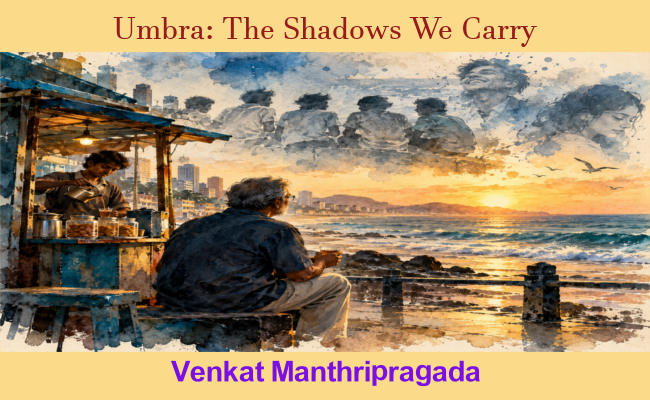

Umbra: The Shadows We Carry
(shadows of memory, grief, and unfinished childhood)
The sea that morning looked old.
Not ancient like mythology. Old like a man who had forgiven too many people and therefore stopped arguing with waves.
The Vizag shoreline carried that peculiar mixture of ozone, salt, fish smell, wet iron railings, and humidity that glued shirt collars to the neck. The air itself felt like a steaming memory.
Vasu walked slowly from the old Park Hotel towards RK Beach.
Thirty years had passed since he had walked there without cholesterol, regret, and WhatsApp groups filled with funeral messages.
Now he walked carefully, like a man carrying invisible glass inside his chest.
The road had changed. Buildings had grown fat. Small houses disappeared. Flex banners had multiplied like philosophical doubts. But the sea remained employed in the same old work — coming forward, collapsing, retreating, and returning again as if existence itself was suffering from forgetfulness.
As he crossed an old hotel and a strange weather-beaten cottage leaning toward the sea like a tired monk, he suddenly stopped.
Tea stall.
Small. Blue tin sheets. Bent aluminium kettle. Two plastic stools. One cracked glass jar with biscuits that looked older than democracy.
Something inside him tore open. Not memory. Memory is too small a word. His entire being suddenly shifted backward in time. For one dangerous second, he was no longer sixty.
His being went back to seventeen.
Sweating in cheap cotton clothes. Half scared about exams. Half drunk on friendship. Carrying impossible dreams and ten rupees in pocket. Listening to sea waves as if they personally cared about intermediate students.
He stood before the tea stall silently.The boy at the stall looked at him and smiled.
“Sir,” he said gently, “I think you are watching a black-and-white movie inside your head. If you want to add colour to it, please have tea.”
Vasu stared at him. The sentence entered him like temple bells heard from underwater. Who talks like that in a tea stall? For a moment he felt reality loosen slightly around its edges.
Then he smiled. “Yes,” and said softly. “Give me some colour.”
The boy poured tea slowly from steel tumbler to glass with the precision of a priest performing abhishekam.
Vasu watched his hands. Something familiar. The eyes perhaps. Or the silence between words.
“Are you… Adi’s son?” he asked suddenly. Now it was the boy’s turn to become still.
“Yes sir. You know my father?” Vasu laughed softly. “Know him? Your father failed in mathematics because he was busy explaining life to everybody.”
The boy smiled faintly.
“Your grandfather died suddenly. Adi stopped studies and ran this stall. But this place became our university. We learned more philosophy here than in the college.”
The boy handed the tea.
“The line about colours,” Vasu said, holding the glass carefully, “that was your father’s line.” The boy’s eyes widened.
“He used to tell us — ‘Future should always be imagined in colour. Otherwise, God may mistake your depression for maturity.’”
The boy laughed. A small laugh. But behind it Vasu heard exhaustion.
“What is your name?” Vasu asked the boy.
“Vasuki.”
Vasu froze. For one second the sea itself seemed to stop breathing. “My God,” he whispered. “That idiot named you after me?”
The boy smiled. “In father’s phone your number was saved as V Snake.” Vasu burst into helpless laughter.
“Oh yes… Damroo was Achyut… Kamina Acharya was Chakri…”
He paused.
“And Miss Pimples?”
“My mother.”
“Soumya,” Vasu said softly.
The boy nodded. Then, almost casually, like someone mentioning rain, “Father passed away two weeks ago, sir.”
The sentence did not land immediately.
Human beings are strange creatures.The mind hears faster than the soul.Vasu kept holding the hot tea though his fingers were burning.
“Passed away?”
“Yes sir.”
“No one told me…”
“We had no numbers. In his phone most contacts were dead already. Either people changed numbers… or disappeared.” The boy smiled faintly.
“Maybe friendship also has expiry date, sir.”
Vasu looked toward the sea. “No,” he said quietly. “Friendship doesn’t expire. Only people do.”
For some time neither spoke. Behind them the sea continued its ancient habit of arriving and leaving. Like everyone else.
That evening Vasu went to Adi’s house.The lane was narrow. Quiet. Old-fashioned. A tulasi plant stood near the entrance. Somewhere inside the house, coffee decoction smell floated like memory made liquid.
Soumya opened the door. For two seconds she looked at him blankly. Then suddenly her face collapsed.
“Snake!!!” she cried. “Our man got carried away with time, bro.” Our fellow left too early. That was all. No dramatic speeches.
Real grief never speaks literature. It speaks broken village language. Vasu held her shoulders.
They cried like people who were not crying merely for one man, but for an entire vanished world.
Vasuki was watching this like an eternal painting. The man in the stories of his father often shown as a huge mountain is crying like a lame duck. He smiled inside. After some time, he brought coffee. Filter coffee. Strong. Fragrant. Slightly overboiled exactly the way Soumya used to make during college days.
Vasu took one sip and closed his eyes. “This tastes like your coffee, Soumya.” She smiled painfully.
“Adi never learned making tea from his father,” she said. “But coffee… he learned from me.”
Then silence. Not awkward but the kind that sits beside old friends like another companion. Outside, rain clouds slowly gathered over the sea. Inside, memories opened one by one.
They spoke about unfinished novels, failed love stories, beach walks, cheap cigarettes, politics discussed without knowledge, and the arrogance of youth which mistakes confusion for revolution.
Then suddenly Vasu asked quietly, “Adi always told me he grew up in a circus… that he had nobody.”
Soumya looked at him for a long moment. “That was not true” she said. Vasu frowned. “He wanted it to be true,” she said softly.
Then she began. “His father was a Chartered Accountant. Strict beyond imagination. The kind of man who thought affection would spoil children the way moisture spoils papad.
One day Adi’s teacher told his parents that he was showing anxiety symptoms. He couldn’t focus. He was frightened all the time.
His father became furious. He said — ‘After spending money on books, clothes, tuition, this fellow is blaming parents for failure?’
That night he beat Adi with a belt. Not ordinary beating. The kind that comes from disappointed ambition. Then he removed Adi’s clothes and made him stand outside the house in underwear.”
Vasu shut his eyes. The sea sound outside suddenly became harsher. “Next morning Adi disappeared,” Soumya continued.
“He left a note on a cigarette packet – I am quitting this life. Hope I never return” His parents thought he had killed himself.”
Vasu’s hands trembled.
“Actually, he took some of his clothes drying in backyard and ran away. He worked in hotels. Railway stations. Tea shops. Ashrams. Circus tents. God knows where all. That circus story… maybe it was symbolic.”
She smiled sadly. “Life really was a circus for him.” The room fell silent again.
Vasu remembered Philip Carey suddenly. The lonely child with the club foot. The humiliation. The endless inner wound. The strange hunger for affection. The way suffering quietly bends the soul inward until it becomes both deeper and darker.
“Some people,” Vasu said slowly, “never recover from childhood.”
Soumya nodded. “Adi used to say — childhood insults do not end when childhood ends. They simply learn adult language.”
Vasu looked at Vasuki. The boy resembled Adi frighteningly around the eyes.
“Did he hate his parents forever?” Vasu asked.
Soumya smiled faintly. “That was the tragedy. Child Adi hated them. Adult Adi understood them.”
She paused. “He said something once… I never forgot.”
“What?”
“He said — ‘Parents are dangerous because they love us through fear. God perhaps loves through freedom. That is why parents create obedient children and God creates lonely people.’”
Rain increased outside. The room darkened slightly.
Their younger days were flowing somewhere deep inside of Vasu. He remembered loud laughter of Adi. Feeding stray dogs before eating himself. Giving free tea to broken students. Philosophy lectures after two Gold Flake cigarettes as if Buddha himself rented a room inside him.
“How did he survive with so much pain?” Vasu whispered.
Soumya smiled gently. “He converted pain into kindness.”
Then after a pause: “But pain took revenge finally.” The sentence lingered heavily.
Vasu looked at Adi’s photograph on the wall. Simple Ordinary face. The kind society never notices. And yet entire universes of sorrow can exist behind such ordinary faces.
That is the cruel comedy of human life. The loud people are often shallow. The silent people are usually carrying oceans. Night deepened. The candle burning slowly and shortening with no trace of where the burnt part gone.
For a moment the room looked outside time. Almost mystical. The sea roared in darkness. Vasu suddenly asked: “Why do good people suffer like this, Soumya?”
She smiled tiredly. “That is a question humans ask only when suffering comes to good people. When bad people suffer, we call it justice.”
Vasu laughed through tears. “True.”
“Maybe existence is not moral at all,” she said quietly. “Maybe it is only conscious.”
Vasu looked at Adi’s photo again. “No… there must be meaning somewhere.”
Soumya shook her head softly. “Adi used to say meaning is not found. Meaning is stitched afterward like embroidery on torn cloth.”
Silence again. Then Vasuki, who had been listening quietly all this while, suddenly spoke. “Father once told me something strange.”
“What?” asked Vasu.
“He said every human being carries two children inside. One child wants love. Another child wants punishment for not receiving love.”
The candle flickered. Nobody spoke. Because suddenly Adi’s entire life stood revealed inside one sentence.
The runaway child.
The tea seller.
The loving husband.
The broken son.
The philosophical clown.
The exhausted father.
The man who healed others with tea while quietly bleeding within himself.
Outside, waves kept collapsing upon the shore endlessly. As if the sea too could not bear its own heart. Vasu stood to leave.
Before leaving, he touched Adi’s photograph gently. “You idiot,” he whispered. “You gave everybody tea… but never sat down and drank peacefully yourself.”
Then he turned toward Vasuki. “Your father was not an ordinary man.”
The boy asked softly: “Then why was he unhappy, sir?”
Vasu stood still for a long moment. Then smiled sadly “Because sensitive people are like open wounds walking under sunlight. They feel too much. The world calls them weak. But actually, they are carrying more humanity than the rest of us.”
He moved toward the door. Then paused again. “Your father once told me something on this beach.”
“What?”
“He said — ‘Maybe God hides inside sorrow because happy people rarely search for Him.’”
Outside, the rain had stopped. The sea smelled fresh. Somewhere in the darkness another tea stall kettle whistled.
And for one impossible second, Vasu truly felt Adi walking beside him again – laughing, smoking, explaining life badly, and turning pain into poetry before disappearing once more into the enormous circus of existence.


పుట్టి పెరిగింది విశాఖపట్నంలో, స్థిరపడింది హైదరాబాద్లో. చాలా కాలంగా బెంగళూరులో ఉంటున్నాను.. సాహిత్యాభిలాష చదవడం వరకే పరిమితమైంది.. లాక్డౌన్ సందర్భంగా కొంచం రాయడం కూడా ప్రారభించేసిన ఔత్సాహిక రచయితను. గురజాడ, కుటుంబరావు, రావి శాస్త్రి, ముళ్ళపూడి, జ్యేష్ఠ, భరాగో, గొల్లపూడి, డాక్టర్ కేశవరెడ్డిగార్లు అభిమాన రచయితలు. శ్రీశ్రీ గారు, సిరివెన్నెల వారూ అభిమాన కవులు.